

The Hardware Gap in Robot Learning
The robotics industry has a data problem. Leading labs estimate they need 100 million to 1 billion hours of egocentric (first-person) data over the next 2-3 years to train advanced manipulation policies. The research community has responded — Open-AoE released 2,000 hours of egocentric video, EgoDex delivered 829 hours with 3D hand tracking, and EgoVerse now includes 1,362 hours of human demonstrations spanning thousands of real-world tasks.
But there is a problem: the hardware used to collect this data is not keeping pace with the demand. Most egocentric datasets today are collected using repurposed consumer devices — smartphones, action cameras, and VR headsets. These devices were never designed for robot learning data collection. They lack global shutter sensors, hardware synchronization, and factory calibration — features that are non-negotiable for producing usable training data.
Ego Camera – Purpose-Built for Egocentric Data Collection
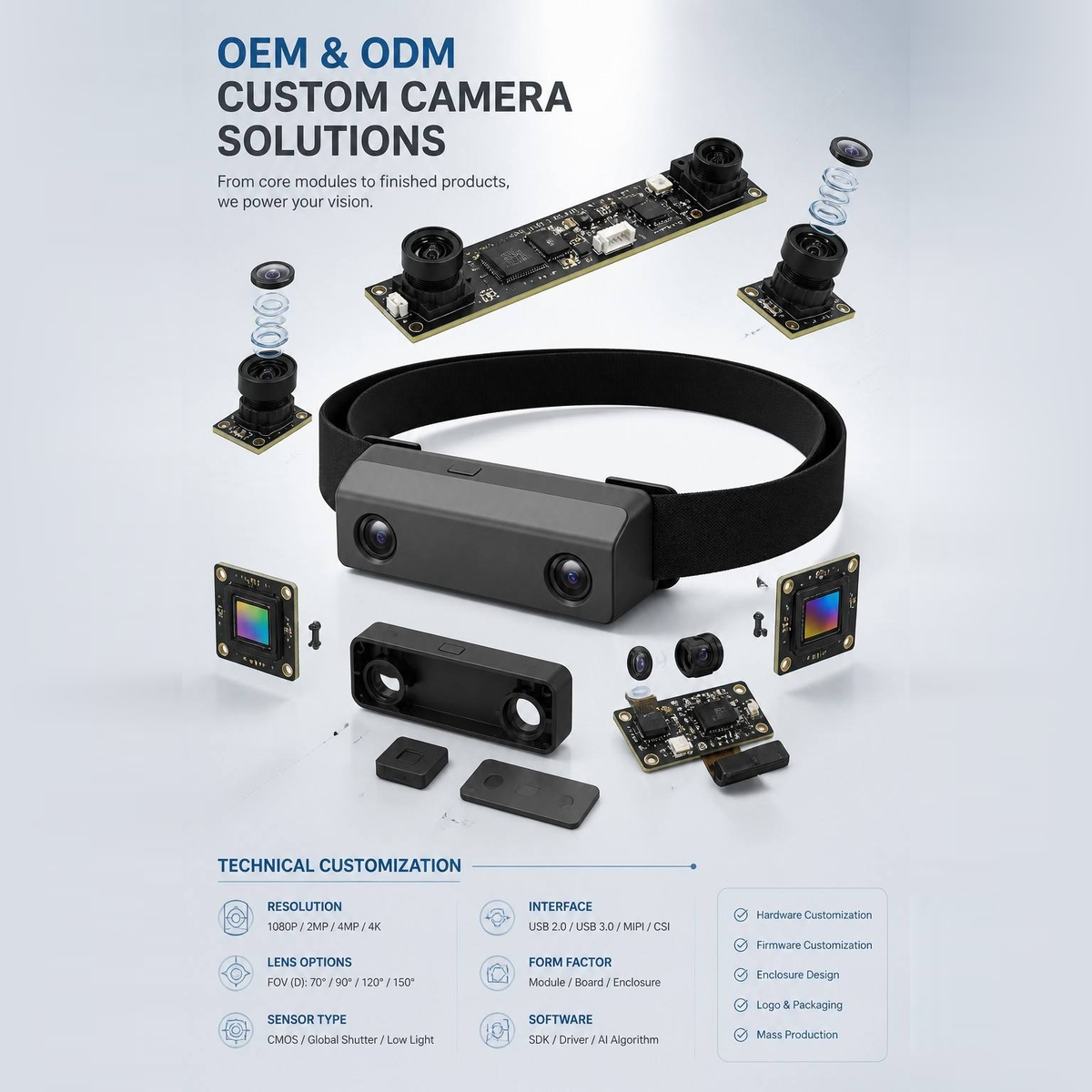
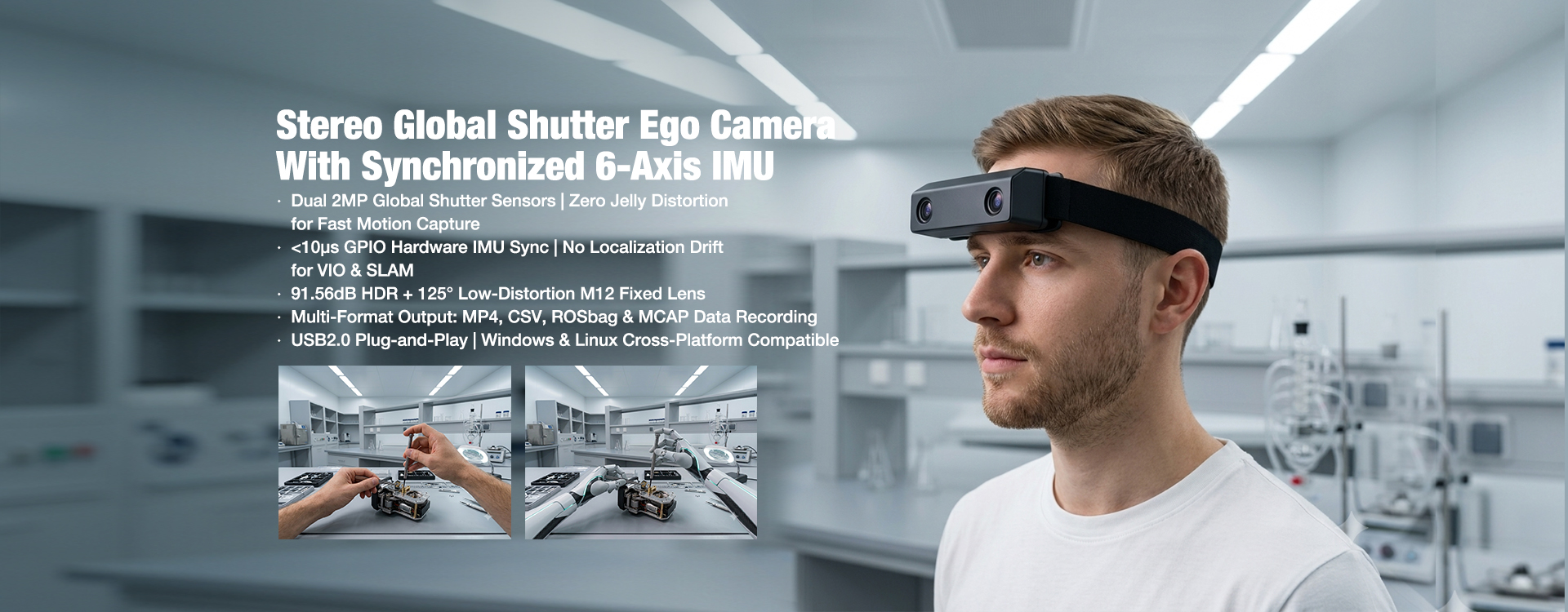
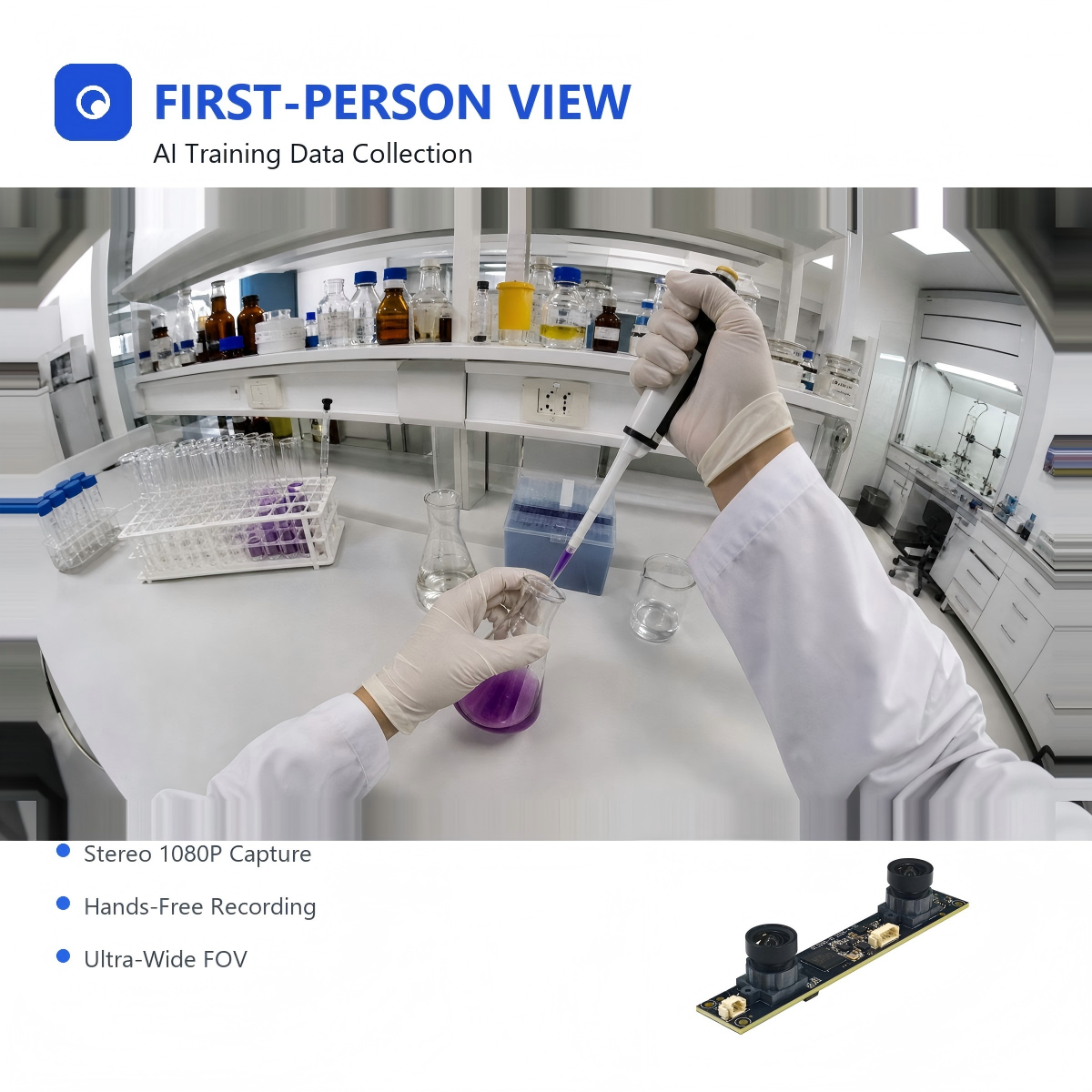
Ego Camera changes this. It is a head mounted stereo camera for robot training data — purpose-built, not repurposed. Designed specifically for wearable data capture device for imitation learningand embodied AI data collection, it addresses the hardware gap that has slowed progress in robot learning.
Core Features
Global Shutter for Motion Capture
Unlike rolling shutter sensors that expose line by line, Ego Camera’s dual global shutter sensors expose all pixels simultaneously. Every frame is geometrically intact — no distortion, no jello effect during fast hand and body movement. This makes Ego Camera an ideal dual lens global shutter camera for motion capture, delivering frames that are actually usable for VLA and diffusion policy training.
Hardware-Synchronized Stereo Vision
Both cameras are triggered by a common hardware signal, guaranteeing left and right frames captured at the exact same instant. This hardware synced stereo camera for depth perceptioneliminates temporal misalignment between stereo pairs — critical for accurate stereo matching, depth estimation, and 3D reconstruction. For researchers building perception systems, this is a synchronized stereo camera for 3D reconstruction that delivers reliable results out of the box.
Built-in 6-Axis IMU with Hardware Sync
Integrated accelerometer and gyroscope provide motion compensation data essential for VIO and SLAM pipelines. This head worn stereo camera with IMU for SLAM offers configurable sampling rates from 100Hz to 500Hz — adapting to different motion dynamics from slow manipulation to high-speed gestures. The IMU is hardware-timestamped and synchronized with camera frames at the nanosecond level — not software-interpolated. This delivers drift-free visual-inertial fusion, fully compatible with VINS-Fusion, OpenVINS, and ORB-SLAM3. It is, in every sense, a head mounted global shutter camera for VIO development.
Factory Calibration – Plug and Play
Every unit comes with a unique calibration file containing intrinsics, distortion coefficients, and stereo extrinsics. No checkerboards. No onsite calibration. This factory calibrated head mounted camera for AI is ready to record in 5 minutes — plug in via USB and start capturing.
Unified Nanosecond Timestamps
Every camera frame and every IMU sample shares the same hardware clock, achieving nanosecond-level temporal alignment. This stereo camera with hardware timestamp for datasetcollection meets the precision standards required for professional egocentric benchmarks and VIO pipelines.
What You Get Out of the Box
- Synchronized left/right stereo video (MP4)
- 6-axis IMU data with hardware timestamps (CSV)
- Unique factory calibration file (YAML)
- Complete SDK/API for Windows, Linux, and ROS
- USB plug-and-play connectivity
Who Is It For?
Whether you are a university research lab, an embodied AI company, or a data collection service provider, Ego Camera is the best wearable camera for robotics data collection for your needs. It serves as a stereo vision headset for AI dataset collection and a cost effective head mounted camera for AI research — delivering professional-grade data quality without the calibration headaches.
Post time: Aug-19-2026


